While Ashkenazim spent the night after Pesach packing up the Pesach dishes, Morrocan Jews have a party called Mimouna. They have been doing this for centuries though no one is really sure why. Unlike most holidays, Mimouna doesn’t appear in any books of Jewish law and it’s celebrated only by Jews of Morroccans and North African ancestry-Syrians don’t do Mimouna; neither do Litvaks or Hungarians.
Scholars point out that since the day coincides with the Yarhrzeit of Maimon, the father of Moses the Son of Maimon (Moses Maimonedes or the Rambam) the feast honors his death-and passage to the next world. (the day of death is a “birthday” of sorts as the soul moves on to another level in it’s journey) The word Mimouna even sounds like a contraction of hiloula and Maimon.
There are others who say that Mimouna comes from Emuna which means faith and that the day is a celebration of faith. In fact the entire Pesach holiday which commemorates the Jewish people’s giant leap of faith following the unseen G-d into the desert without packing sandwiches is the consumate holiday of faith. The mystics say that faith energy is in the air at Pesach time and that if we plug in we can recharge our faith battery for the entire year so maybe Mimouna connects to that.
In old Morrocco the Arabs visited their Jewish neighbors bringing gifts of sourdough starter. Because sourdough, which was the premodern and more natural form of yeast is hametz incarnate the Jews discard theirs before Pesach .This gift helped them start their post Pesach baking. In the traditional blessing is “tirbachu u’tis’adu”, Morrocan or Judeo-Arabic meaning be
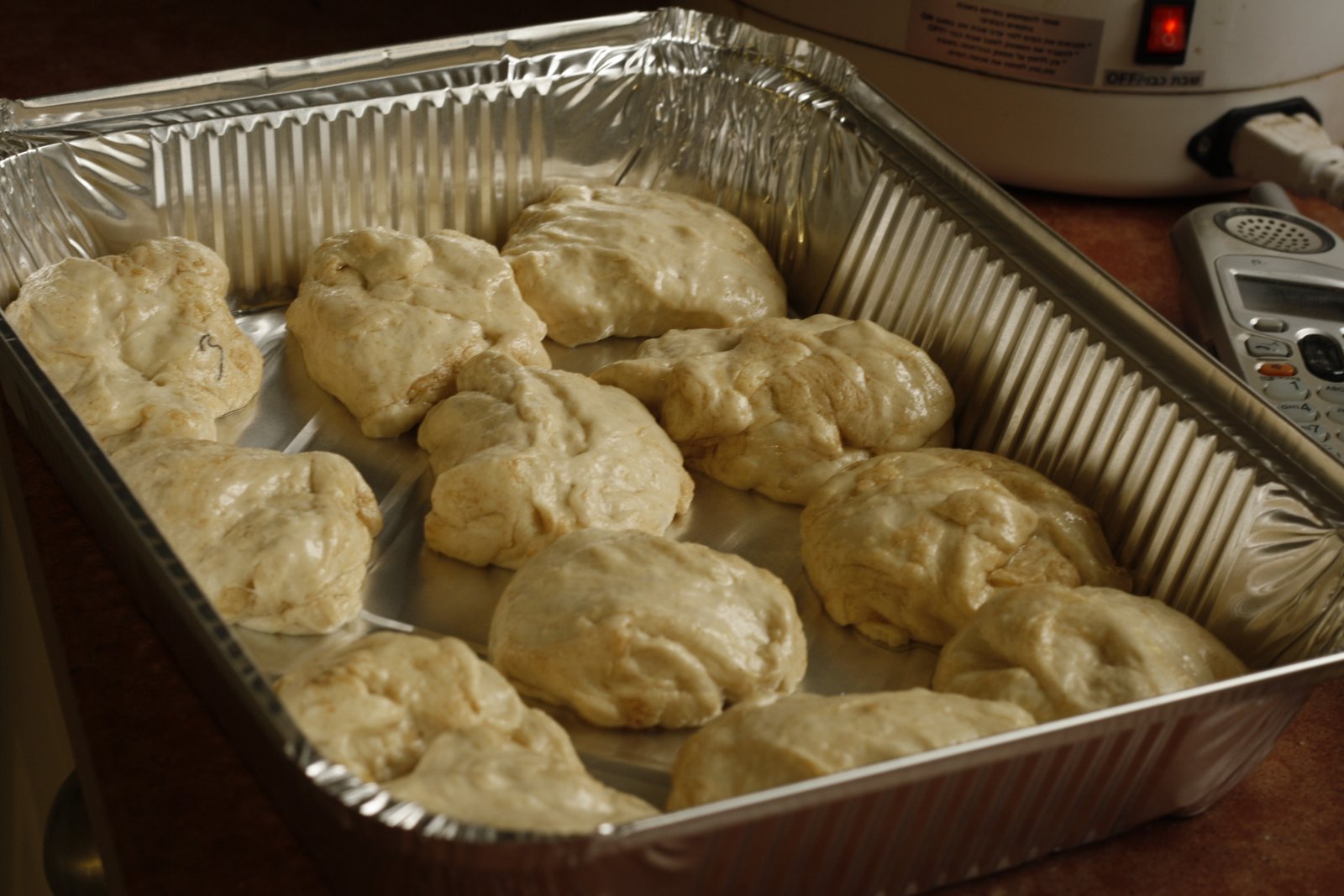
Mufleta dough

streching out the pancake
The first dish the Jews would make was a leavened pancake called Mufleta. Mufleta is flatbread, similar in taste and texture to Indian chappati. It is very tasty, especially when topped with honey or slathered with a honey butter mixture and not at all complicated to make once you get the hang of it.
Mufleta—enough for 12 pancakes.
3 and ½ cups of flour
½ tablespoon yeast
½ tablespoon salt
½ tablespoon sugar
1/3 cup of vegetable oil (approximately)
1 and ½ cups lukewarm water
1. Dissolve yeast in water. Add sugar. Combine flour and salt. Mix in flour gradually and knead until you’ve got a soft batter.
2.Pour about a tablespoon of oil on top of the batter so that it is covered by a thin film of oil. It should look shiny
3.Cover the dough with a kitchen towel and let it rest for an hour
4. Cut the dough into 12 pieces. Each piece should be about the size of a medium sized apple.
5. Let the dough balls rest for 10 minutes
6. Create an oiled work surface. You can pour a thin film of oil on top (about a tablespoon)directly onto a granite countertop or a marble cutting board. Using the palms of your hands work the ball into a thin pancake (it may break in places—that doesn’t really matter
7. Heat up a tablespoon of oil in a frying pan. Slide the first pancake into the hot pan.
8. Cook until it starts to brown on one side and the flip the pancake over (it should take about a minute to brown)
9.The layer the next pancake on top.
10. Flip the pancake tower over so that the new pancake is touching the surface of the frying pan. When it browns flip over and layer a new pancake on top. Flip until brown and then layer a new pancake. Keep on doing this until your dough balls are finished. In the end you will have created a tower of mufletot, one on top of the other.
If you can , get two people on the job. One person can stretch the dough into pancakes. The other can supervise the cooking and flipping. In a pinch one person can do the entire job.
Separate the pancakes—they should come apart easily and serve right away with silan, melted butter, melted butter mixed with honey or jam. Though the tradition is to have them with something sweet they can work well with a savory dip too.
