Na’an : Afghani Jewish Flatbread


You can make this at home!

For years, even decades, I avoided baking bread. Bread baking? Me?

Bread has strange ingredients like yeast-now what does one do with that? And even stranger instructions. Proof the yeast. What kind of proof? Is this something legal? Punch down the dough Why? What did the dough do to deserve such violence?

Meanwhile, my friends had started baking challahs and I had to try. Working DIY style at home I make every possible mistake . Some weeks my loaves were as dry as doorstops. Sometimes they tasted like stale coffee cake. Yet I kept chugging and , thank G-d my challahs today are light and fluffy and yummy!

Now as to other breads, I never bothered. Mid week breadbaking? Who had time for such things? Let me tell you, once you get into the swing of it, bread baking can be almost as easy as boiling up a pot of pasta. If you use whole grain flour, your bread will be healthier and cheaper than store bought and slipping whole grains into bread is the best way to get them into my kids’ bellies.

This week’s recipe. Na’an or Afghani Flatbread comes from Gil Marks’s Encylopedia of Jewish Food . I baked a batch on Sunday, when I was fasting and feeling too weak to drive to the bakery. If you have a standing mixer, Na’an takes minute to put together. Rising and baking time are relatively short especially on hot days.

According to Marks’s Na’an is the traditional bread of Afghani Jewry-yes there are Jews from Afghanistan, though I don’t think the community exists today. Not only is this bread eaten before and after Tisha B’Av, it’s a Sabbath bread as well. Don’t expect a big fluffy loaf. This is a flat bread-like chewier and more savory pita . Becasue it lacks a pocket and it’s too thick to roll, don’t make sandwiches but na’an is a perfect landing pad for dips.

Na’an

From the Encyclopedia of Jewish Food, by Gil Marks

2 t instant yeast

1 and 1/2 cups tepid water

1 t sugar or honey

3 T oil (olive is good)

4 cups whole wheat pastry flour (in Israel Rubinfeld 75- or a blend of white, and whole wheat. You could add spelt to the blend. I would avoid coarse mills)

2 t salt

2 T nigella seeds (ketzach and sesame seeds for sprinkling)

Mix the yeast and water. Add sugar and oil. Slowly add flour and salt.

Using dough hook knead on a slow setting until the mixture forms a ball.

Oil the ball (that means pour a tablespoon of oil into the bowl and roll your dough ball around until it developes a greasy skin)

Cover with a damp cloth and let the dough rise until it’s doubled in bulk. (Meanwhile take a nap)

Punch down the dough. Cut it into six equal pieces.

With a rolling pin roll each piece into a rectangle. (don’t worry about being to perfect. don’t think the Afghanis who made this in the desert made loaves that looked like they came from Martha Stewart’s test kitchen)P Ieces should be about one and one half inches thick.

Wet your fingers and press them inside the dough to make grooves. Pour the sesame or nigella seeks inside the grooves.

Let the pieces rest for 10 minutes

Bake in on the lowest rack of a preheated oven on high. 475 F 0r 245 C.

Baking time 5 to 10 minutes or until the bottoms of the Na’an start to turn golden brown.

Eat right away or freeze. If you freeze you can pop the slices into the toaster. Yum.
Reviving the Dead: Health Salad from the Second Avenue Deli


Ever since I started this blog I started to collect cookbooks. Since Israel doesn’t have big box bookstores, and the only game in town is Steinmatsky’s with it’s odd and quirky stock , I order online. On trips Stateside I stuff my acquistions into my hand luggage and handbag, risking overweight charges and shoulder blisters.

This time, a kindly American Airlines clerk let me to reconfigure my bags at the airport to avoid the charges. I can’t say the same for the blister. But I don’t regret my overshlepping because among my newest purchases is a rare gem, Arthur Schwartz’s Jewish Home Cooking. Coffee table sized with lovely pictures, Schwartz has collected all of the alte heim recipes that New York Jewish restaurants offered before they switched over to Penne ala Vodka and Sushi.

One particularly delightful surprise-and what is a good cookbook if not a collection of edible surprises- is the original Second Avenue Deli health salad recipe. During the latter part of the last century, New York’s Second Avenue Deli was famed for not only for it’s corned beef and pastrami but also for the ubiquitous stainless steel buckets of sweet and sour slaw called “Health Salad.”

Schwartz surmises that the name refers to the salad’s lack of mayonaisse and abundance of vegetables. It’s lightly dressed albeit with plenty of sugar, which is arguably not the most health promoting of foods though , I don’t advise cutting it down for fear of upsetting the subtle sweet and sour balance . I made the recipe for this Shabbat and it was accurate.

I’m thrilled to have stumbled on this recipe. Until I opened Schwartz’s book, I’d relegated it to my mental attic of gustatory memory along with other long lost tastes like Shmulka Bernstein’s fabled spare ribs and rigo janci from now defunct Louis Lichtman bakery.

I see this recipe as the culinary equivalent of the revival of the dead, just right for the Nine Days and other times too.

Second Avenue Deli’s Health Salad

from Jewish Home Cooking

Yield : 8 cups

1 small head green cabbage (about the same as one bag shredded)

2 medium carrots peeled

1 small green bell pepper

3/4 cup white vinegar

2 tablespoons olive oil

1/2 cup white sugar

1 T salt

1/2 t freshly ground pepper

Shred cabbage and carrot and cut the pepper into thin slices

Whisk together dressing ingredients and toss well.

Refrigerate. This salad needs about eight hours in the fridge and should remain crisp and fresh tasting for up to two weeks. Great for the summer. Don’t freeze.

Smallpox for Supper: Only Kidding.For the Nine Days Majadarah (Rice and Lentils Pilaf)


Yes, this is one of the wierdest food facts ever but this week’s dish, Majadarah, literally means having smallpox in Arabic. I learned this from Gil Marks’ amazing Encyclopedia of Jewish Food-one of my favorite reference books ever (and his recipes are good too!).

English: Green Lentils (Lens culinaris) in Mac...

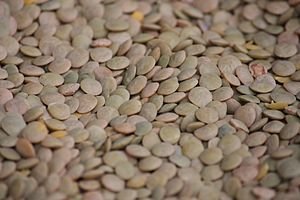
English: Green Lentils (Lens culinaris) in Machne Yuda Market, Jerusalem עברית: עדשים ירוקות (Photo credit: Wikipedia)

The brownish lentil bits in the white rice resemble the disease. How’s about that for a bit of black premodern humor?

Don’t let that put you off because Majadarah is a dish you want to try. Not only is it rich in flavor, it’s also high in iron ,fiber and protein.

Because it’s pareve , Majadarah features prominently in both Jewish and Arab cuisines. That shouldn’t be so surprising considering that we are cousins.

This week the Nine Days begin, the pre Tisha B’Av mourning period when Jews refrain from meat and wine.With their closed spherical shape lentils are the food of mourning. Closed circles, lentils which have no opening are said to “lack a mouth,” just as mourners who cannot greet others or open conversations are as it were, lacking mouths. On Tisha B’Av we are all mourners grieving the destuction of the Temples and every Jewish calamity thereafter.

But don’t save Majadarah for sad days. Gil Marks says that it is also served on Shabbat alongside Huevos Haminadoes, the browned eggs cooked in the Adafina, the long cooking Sabbath Stew (chulent) Please G-d the Messiah will soon come and we will eat Majadarah in Sabbaths to come.

With three different ingredients, each of which is cooked separately , Majadarah can be mess-making but I have a shortcut Presoak the lentils to soften then up. Then cook them together with the rice. Result:Two dirty pans instead of three. Hooray!

Easy Majadarah

1 cup of green lentils (don’t even think of substituting red because red will turn to mush)

2 cups of basmati rice (white)

1 1/2 T vegetable oil

2 t salt (divided .Half in the rice and half in onion sauté)

¼ t cumin

¼ t black pepper

Three vidalia onion sliced into thin crescents.

Soak lentils in water for 4-5 hours to soften .

Drain lentils.

Saute rice briefly in oil . Add 1 t salt and drained pre soaked lentils

Add 6 cups of boiling water. Bring to a boil . Then lower flame and cook covered for 20 minutes .

While the rice and lentils are cooking together slice three onions into thin crescents and saute in a non ceramic non stick frying pan . Stir frequently. Add ¼ t pepper, 1/4 t cumin and 1 t salt to the sauté. The onions need to become dark brown.

Spoon the rice and lentils into a serving platter with the fried onions on top. (sorry no picture. Having some problems with mycomputer)

Pickled Salmon for the Sabbath: A Taste of the World to Come


If fish could be said to have families, then pickled salmon would rank as gefilte fish’s forgotten sister. Everyone remembers gefilte. The old ground carp has been frozen and jarred even served up in three layers like a petit four. Salmon does star on the foodie pantheon but that’s only when it’s grilled on cedar planks or soaked in Teriayki sauce .

Pickled salmon deserves a revival. Not only is it richly flavorful, it is low in calories, packed with Omega 3 and it even improves in flavor after two or three days in the fridge.

Don’t let the “P” word put you off. Pickled salmon is a snap to make. No need for sterilized jars or wooden barrels.

Of course fish is perfect for the Sabbath. The gematriya, the numerical value for dag, the Hebrew word for fish is seven and the Sabbath is the seventh day. A coincidence? I don’t think so. Our sages say that in the world to come Hashem will serve a banquet to the righteous-and what will be on the menu? Leviathan which is a fish. Since my fish monger doesn’t stock Leviathan, I’ll have to settle on salmon and so will you. Still this is a sublime way to enjoy it.

Pickled Salmon

10 slices of salmon (about two lbs or 1/2 kilo) sliced in half
1 and 1/4 cups of vinegar
2 cups of water
3 bay leaves
1 T pickling spice
1 T peppercorns (optional)
1 clove garlic(optional)
1/2 cup of sugar
1 t salt
1 onion whole
1 lemon quartered
1 onion sliced
In a four quart (medium sized) pot boil everything together except for the fish and the lemons. After you bring this mixture to a boil let it simer for 15 minutes. Then add the lemon slices and simmer for 15 minutes longer. Remove lemon slices. Squeeze out the lemon juice from the lemons into the liquid and add the fish. Cook on low flame for 25 minutes. Cool and refrigerate. Store in glass jar or plastic container. Don’t freeze but this will keep for a week in the fridge.
Refrigerate and eat. Yum

Another Wierd Hungarian Name: Uborka Salata or Cucumber Salad


Maybe my ears are a bit fuzzy, but I could have sworn that the Hungarian word for cucumber was ugorka.Yet when I looked online the word I found was “Uborka”. The truth is that I don’t speak Hungarian . My vocabulary consists of 25 or so random words, not enough to say anything meaningful. My parents refused to teach me more-they didn’t want their children speak the defiled tongue of their oppressors though they spoke it all the time themselves. It was their mother tongue even though “mother” was a toxic parent.

In any case, Uborka Salata is one of my favorite all time foods.

My father owned this dish. A typical mid 20th century male he wasn’t usually the family cook. My Mom was but every so often he’d take over her small galley kitchen using a butcher’s knife to slice the cucumbers into rice paper thin rounds. Then came the sweating and squeezing, my father pressing the diaphonous slices with his large hands. Finally he’d lay them in their marinade, an an exquisite sugar, vinegar blend with just a touch of black pepper.On hot days he’d throw in ice cubes so that we could enjoy the salad chilled.

Sadly, my father is gone and so is his recipe. My Mom gave an approximation, a “taste it” admixture which I’ve tweaked for this post. .

Interestingly, there is a sour cream slathered Hungarian cucumber salad. Isuspect that my father’s recipe grew out of the Jewish need for a pareve variation for meat meals. Uborka Salata goes exceedingly well with breaded veal cutlets and chicken paprikas . It’s also a nice alongside salmon.

Uborka Salata or Hungarian Cucumber Salad

5 medium sized cucumbers peeled and sliced thin. Leave some of the peel on to create a zebra stripe effect. (I’m referring to Israeli cukes. For English hothouse cukes, use 2 and peel them completely)

1 small onion

1 tablespoon kosher salt

3 tablespooons cider vinegar

1 and 1/2 tablespoons white sugar (don’t use brown)

1/2 cup water or 3 ice cubes

1/8 teaspoon black pepper

1/2 teaspoon sweet Hungarian paprika (optional)

Slice the cucumbers into very thin rounds. You can use a food processor or mandoline.

Mix cukes with the salt and leave them to sweat for up to two hours (20 minutes at least )I do this in a colander set over a bowl.

After cucumbers are sweated, squeeze out the excess liquid with your hands and wash to remove the salt.

Add one small onion sliced very thin

Mix sugar, vinegar, black pepper marinade

Add cukes and onion. Add water or ice cubes and refrigerate.

Don’t freeze but this dish can keep for up to 10 days in the fridge. Yum.

Feeding the Inner Child: Rakott Krumpli, Hungarian Dairy Casserole, A comfort food from pre War Europe.


Kids don’t think their parents need comfort or comfort foods. Kids, especially really teeny ones don’t think their parents need anything at all-not food or sleep or privacy. But they do. As a battle scarred veteran with 23 years on the front lines of motherhood, I know that Moms sometimes need to scarf down a meal returns their taste buds to childhood .

For my Mom, Rakott Krumpli that kind of meal. In prewar Europe my Mom literally grew up on this dish, a Hungarian peasant classic whose literal translation is pleated potatoes. Ironically, whenever she’d make it-when I was a kid, and even as a young adult, I’d refuse to a taste. Sour cream, potatoes, and hardboiled eggs all baked together? Yuck and double yuck. But now that I’m getting older I want to savor the tastes that nurtured my nurturer . And after making three Rakotts in the kosherhomecooking.com test kitchen which happens to be in my house, I can say that this is good stuff, hearty, savory and extremely filling.

Since my Mom provided a rather approximate recipe, I googled up Rakott Krumpli in an attempt to track down more precise measurements. That brought me to a YouTube video of some honest to goodness Hungarians cooking my mother’s dish and talking about it in the Mamaloschen which in my Mom’s case is Hungarian.While my Mom insists that Rakott isn’t a typically Jewish dish. the YouTube recipe was swimming in kielbasa, sauted pork sausage tucked in between the “pleats”alongside the potatoes, sour cream and hard boiled eggs.

That says a lot. As much as we Jews identify with the host culture-to this day my Mom calls herself a Hungarian, we are Jews and in that way quite distinct in our foods and way of life.

I don’t know what the youtube Rakott tastes like and unless someone creates an excellent pareve kielbasa I will never find out. Meanwhile, my Mom’s Rakott is great throw together dish for a quick weekday supper, nourishing, tasty, and of course, comforting.

Recipe to serve 6

6 medium potatoes cooked in their skins until fork tender (about 20 minutes)

3 eggs hard boiled

1 t salt (or more to taste)

1/8 t white pepper

1 t paprika (optional)

2 Vidalia onions sauteed in 2 T butter (optional)

2 handfuls of grated yellow cheese, any kind.(optional)

2 cups sour cream

Slice the boiled potatoes potatoes into 1/4 inch rounds

Slice eggs into 1/4 inch rounds (could be bigger pieces if eggs seem to be falling apart. This is a very easy going dish. Don’t worry about things being perfect).

In a buttered casserole layer potatoes, eggs, grated cheese, and sauted onions sprinkling salt and pepper over the potatoes.

Continue layering until casserole is full. Top with the sour cream.

Bake at 350 for 40 minutes or until top is brown. Doesn’t freeze well but will keep in fridge for up to four days and reheats nicely in the microwave. Enjoy

Dieters can substitute butter for Pam and use low fat sour cream and cheese.

Home Made Pasta: A Bad Idea


Martha Stewart

Martha Stewart (Photo credit: Wikipedia)

A curse on your head Martha Stewart,

Maybe not a curse but perhaps a friendly pigeon could fly above you and do what pigeons do on top of your perfectly streaked coif.

I want revenge. Frankly Martha, I’m good and mad In your cookbook, the old one, that came our before food porn and coffee table cookbooks, you led me to believe that it was easy to make pasta at home.

Home made pasta, won’t that dazzle my guests I thought somewhat pridefully.

So I took out my decade old but never used and still in the original package pasta attachment.

I couldn’t figure out how to put the darned thing together-maybe that was a cosmic hint but then my 10 year old genius of a son snapped here, and turned there and voila, my machine was fully operational. I made the dough following your recipe Martha, Then I put it in the pasta maker.

I was expecting play-doh extrusion. Insert dough glob on one end watch the spaghetti strands come out the other. That happened all right but it took hours, the dough lumbering through the machine with excruciating slowness. It might have taken days, even weeks for that lump of dough to turn into enough noodles to serve four adults if I hadn’t given up in despair.

After almost a day and a half minus time for sleeping and household chores I had 15 home made spaghtti strands all of them hopelessly glued together after immersion in boiling water. So I bailed out. I threw the stands and the remaining dough into the trash and cooked up a pot of Barilla..

This slideshow requires JavaScript.

I did use your sauce. Well, Martha, you blew it on the pasta, but you redeemed yourself with this sauce which I now offer.

Easy Alfredo Sauce adapted from Martha Stewart

Simmer one cup of heavy cream (15 percent fat is fine too) Don’t let it boil. Slowly dribble in two egg yolks and mix together. Then add 1/2 cup grated cheese (Martha says Parmesan but I used Jerusalem generic yellow and it tasted just fine) and a large lump (3 T) of butter. Let it all melt together. Keep the flame very low and stir continually with a wooden spoon guarding zealously against congellation. (my sauce did congeal a bit but it still tasted fine)

Add a pinch of salt and pepper and if you like a micro pinch of nutmeg.

You can also add , 1/2 cup of steamed broccoli or sauteed mushrooms are nice.

Serve over the pasta. Yum.

Start your diet the day after.

Hooked on Sourdough 2:The Easiest Sourdough bread recipe on the planet


Amazing as it sounds, Alaska Sourdough Soda bread is cheaper and easier to bake at home than it is to buy, even without a bread machine-unless you happen to live in close proximity to an excellent and extremely inexpensive bakery.

I got this recipe from Ruth Allman’s 1979 classic “Alaska Sourdough” a lovely volume that is equal parts cookbook and history. Like most of Allman’s recipes, this bread comes from the Alaska 49rs who made it with the starter they carried in their packs.

Since it requires no proofing, shaping or braiding and has only one rise, Sourdough Soda Bread is perfect for people on the go. Working people can put the dough together the night before,let it rise overnight in the fridge and bake it the following morning. As it excludes yeast and eggs this bread accomodates special diets though it doesn’t taste dietetic. Crusty on the outside and soft on the inside, Sourdough Soda bread is hearty, yummy and despite it’s name not even slightly tangy. And it’s great for kids. Let your kids help you make it , not todders- they will throw the batter all over the kitchen, but older children. A teenager could probably make the whole thing on his or her own.

Alaska Sourdough Soda bread is also extremely healthy. While my family thumbs up it’s collective nose at quinoa and brown rice, they will happily eat whole grains disguised as bread. The loaf I baked on Friday morning was gone well before lunch.

Of course, for Jews bread makes a meal. Bread requires netilat yadaim the ritual pouring water over the hands from a cup fashioned after the laver the High Temple Priests (Cohanim) once used. This reminds us that even the humblest dining table is an altar and eating is a holy act . A bread meal ends with Bircat Hamazon, the Grace after Meals when we thank Hashem for sustaining the entire world with “grace, kindness and mercy.’ The grace or in Yiddish bentsching is among the holiest of prayers . Our sages teach that a person who recites it’s words with careful concentration will not suffer poverty.

Good advice in tough economic times.

So here’s the recipe. Please let me know how it turns out.

Sourdough Soda Bread adapted from “Alaska Sourdough”

2 cups of sourdough starter (see previous post for recipe and instructions)

2 T oil

1 T sugar

1/2 t baking soda dissoved in 1/2 cup of water

4-5 cups of whole wheat flour

Mix starter, sugar and oil. Add flour and knead using a dough hook until a ball forms (under five minutes)

Spray two loaf pans with Pam .Put the dough into the pans.You’ll need to strech it a bit but don’t worry. It will rise and fill the pan.

The dough will rise in the baking pans. (use pans with high walls for larger slices)

Rising time can be three hours or more depending on kitchen temperature. Of course rising is quicker in a hot kitchen on a hot day. but note that starter rises more slowly than yeast. When I did an overnight refrigerator rise I let the dough sit for an additional hour before baking.

Preheat oven to 400 F or 200 C .

When the dough in the pan has doubled in bulk bake for 45 minutes or until browned on top and bottom.

Freezes well

Hooked on Sourdough Part 1


As much as I detest the addiction metaphor , (chochoholic, fashion addict , etc) I can’t find a better way to describe my relationship to sourdough. I’m hooked!

Sourdough also known as wild yeast, is of course a magical combination of flour, warm water and a bit of fermented dough .

Until commercial yeast became widely available, every home had a crock of sourdough starter. Because starter is used and then replenished it can live indefinetly . Some starters date back decades, even centuries. In Uncle John’s Bread Book, Uncle John, the book’s eponymous author described his father bringing along a crock of starter when he emigrated from Germany to the US during the early decades of the 20th century.

Of course long term starter saving was never a Jewish practice because of Passover. Starter, known in Hebrew as seor, an interesting sound alike to sourdough, is Hametz and must be discarded before Passover.In his Encyclopedia of Jewish Food, Gil Marks claims that in the Middle East, the Arabs dropped in on their Jewishe neighbors’ post Pesach Mimouna celebrations with gifts of starter for the Jews to use in their pita baking.

Of course one can mix up a fresh batch of starter .I suspect that is what the majority of our ancestors did after Pesach being surrounded by often hostile neighbors whose food they would not eat.

Daunting as it sounds, starter making is quite easy. I’d say, give it 10 minutes top to get underway. But after that you’ll need to wait a week for the fermentation to get underway. No instant but in nanosecond immediate gratification culture it’s wonderful a wonderful lesson when all you can do is wait.

This is what a sourdough starter looks like once fermentation has began. Note the tiny bubbles. They are a sign that your starter is ready.

Sourdough Starter from Joy of Cooking

25 oz (2 ½ t) active dry yeast or instant yeast

2 cups warm water

2 cups all-purpose flour

Mix together in a non-metallic bowl using a wooden spoon. Cover loosely and leave in warm place 4 to 8 days. When bubbly with a pleasantly sour smell use and after that refrigerate. If it turns a strange color (green or orange) discard

To replenish, discard all but one cup of the starter. Add the cupful to 1 cup all-purpose flour and 1 cup lukewarm water. Let stand overnight until fermented and bubbling and then use or refrigerate.