 Some people go for walks or sit in coffee shops when they want to have heart to heart talks. Not Rabbi Shlomo Freifeld. When Rabbi Shlomo Freifeld wanted to have a deep conversation one of his students, he’d invite that student to help pickle the herring. Fish pickling on the curriculum at Shear Yoshuv, the Rabbi’s yeshiva in New York’s Far Rockaway neighborhood, but Rabbi Freifeld wasn’t just any rabbi. Rabbi Freifeld was a spiritual father to his students, many of them broken young men.
His daughter Rebetzin Peninah Rothman recalls that Rabbi bought his herring, straight from the barrel –a dozen or more fish at a time, enough to feed fifty hungry men. Then he’d don a plastic apron and together with a student sous chef, they’d start the pickling process so that the fish could be eaten at the third meal of the Sabbath.
Of the three Shabbos meals, Shalosh Seudos which is the Yiddish name for Seuda Shlishit, literally “third meal,” is the most otherworldly of the three Shabbos meals. The menu is simple. Cold and often pickled foods are featured because the focus isn’t on the food—it’s on creating a stirring atmosphere, through storytelling and singing of slow, soulful songs.
From his daughter’s description, the late Rabbi was in a Shalosh Seudos state of mind while he pickled. As he worked he hummed a melody from the Psalms “Hoshia es Amecha,” Redeem Your People …and Bless your inheritance,”. Maybe that song, which is really a prayer was the secret to the Rabbi’s success in redeeming the souls of his students, lost young men whom he helped to build new lives.
The pickled herring recipe is actually quite simple and turns out very yummy. Don’t let the word pickling frighten you. With a sharp knife, the process is quite simple and actually fun and doing it yourself is a lot cheaper than buying the same pickled herring from an appetizing store. Hum “Hoshia es Amecha” and think of Rabbi Freifeld while you’re pickling.
This is my adaptation of Rabbi Freifelds’ fish recipe given to me by his daughter Rebetzin Peninah Rothman
Ingredients
One salt herring (approximately seven inches long)
Pickling spice
Bay leaves
Dried chili peppers
One medium onion
Sugar
Vinegar
1. Buy one whole salted herring—we’re talking about silvery grey fish with white flesh ( caution do not use maatjas herring)
2. Fill a medium sized bowl with cold water and place fish inside. Refrigerate. After 24 hours change the water.
3. After the fish soaked for 48 hours slit the fish across it’s belly and gut it. Remove spinal column, fins and tail and then slice it into small pieces about the size of rummikub tiles.
4.Submerge the squares in cold water and let them sit there for another 24 hours.This will extract the saltiness completely and leave you with a very mild tasting fish. Caution: keep the fish in the fridge at all times.
5. On the third day marinate the slices in a solution of ½ to ¾ cup of sugar (depending on how you sweet you like it)and one cup of vinegar. Add a handful of pickling spice, bay leaves , one dried red pepper, one onion sliced into rounds. Store in a closed container
6. The fish should marinate in the fridge for at least 24 hours until it’s eaten.
Serves four to six
Stuffed Cabbage for Purim
It is centuries old custom to serve stuffed cabbage on Purim. Cabbage was of course a staple food in Eastern Europe, abundant and easy to store. The connection to Purim? Gematriya again, the ancient art of letter number equation. Cruv which means cabbage has the same letters and numerical value as Baruch which means blessed and is adjective used to describe the Megilla’s hero in the Shoshanat Yaacov poem which we recite after the reading of the Megilla.Stuffed cabbage is another concealed food-the meat is hiding under a cabbage blanket and that fits into the hidden theme of the holiday. Esther concealing her identity, G-d concealing Himself as it were-the name of G-d is conspicuously excluded from the Megila and all the miracles are natural ones-no pyrotechnics ala the splitting of the sea at Purim.
Stuffed cabbages also resemble Torah scrolls-especially when you serve them two at a time. At Purim the Jewish people reaffirmed their allegiance to the Torah.
Here’s a recipe for Stuffed cabbage, sweet, Galicianer or Polish style,this time.
Ingredients
1 savoy cabbage (no stuffed cabbages can’t be red!)
Five small onions.
I can sauerkraut (optional)
1 lb (or 500 grams) chopped meat. I mixed turkey and beef
One cup tomato juice
½ c brown sugar
⅛-¼ tsp of black pepper
Juice of 1 fresh lemon
2 eggs
½ cup white rice
Stuffing Preparation
1. Sauté one small onion.until soft and brown.
2. Add rice to sauté and mix together for a minute. (this is just an initiall sauté; the rice will cook later on when it’s stuffed inside the cabbage rolls)
3. In a separate bowl combine chopped meat with ¼ cup tomato juice, (or ¼ cup water plus 1 and ½ tbsp. tomato paste) two eggs and salt and pepper to taste.
4. Add fried onion and rice to meat mixture. Note : in this recipe you don’t precook the meat. It cooks later with the cabbage.
.
Cabbage
1. Boil two inches (about 4 cups) of water on the bottom of a large pot (Dutch oven)
2. Insert your cabbage. It can take 10-15 minutes for the cabbage to soften enough that the leaves can be pried loose.
3. Remove cabbage from steaming water.
4. Delicately separate the leaves one at a time.
Tips: You’ll probably be able to get two or three loose at one time and then you’ll return the cabbage to the steaming water to soften some more. This takes patience.
The leaves must be pliable enough to fold and roll.
The art of cabbage stuffing
1. Once you can separate a few outer leaves from the cabbage (small tears don’t matter but try to leave them intact) take a paring knife and thin the vein at the center of the cabbage (a big fat vein will make rolling impossible) taking care not to tear the cabbage leaf.
2. Place a tablespoon of filling at the center of your leaf. (if your leaves are small use less filling.).
3. Roll up the cabbage and press it on both sides to make sure the filling is secure inside. If there’s a small rip on the side, the cabbage will still survive, but try to avoid major leaks.
Cooking
1. Line the bottom of a large pot or Dutch oven with quartered onions and sauerkraut. (It’s yummy to throw in a few beef bones and a piece of flanken,)
2. Layer the cabbages on top of the sauerkraut and onions.
3. Continue layering until you’re done.
4. Pour a cup of tomato juice, a half cup of brown sugar, the juice of a lemon and between 1/8 to 1/4 teaspoons of black pepper (add pepper to taste) .
Add 250 grams of tomato paste and 250 grams of water along with more brown sugar and pepper to taste and a handful of raisins.
Chickpeas for Purim
For years, a neighbors always sent us a plate of chickpeas for Purim . None of us understood the gift. Why chickpeas? I never bought chickpeas, not even in cans.
Weren’t the only people who ate chickpeas were Italians, vegetarians or people who were having Shalom Zachor-a Friday night party celebrating the birth of a son at which chickpeas are served.
I just didn’t get it. I assumed that my friends were crazy for chickpeas and they wanted to share their passion with us, until just recently. Call me a slow learner, but when I first learned that Esther ate a vegetarian diet at Ahashverosh’s palace I didn’t make the link to chickpeas, until now.
Recently, I figured out the reason for my friend’s gift. There is an ancient custom to eat them along with other legumes and seeds on Purim (called in Hebrew zaronim) to recall the fact that Esther ate them in Ahasherosh’s palace. The food wasn’t kosher, so what was there to eat-legumes, seeds and grains. All around, Esther didn’t have an easy life. Her marriage to Mordechai ended when she submitted herself to Ahashverosh to save the Jewish nation. And as to nachas from the kids -some scholars say that Darius, the Persian King who permitted the rebuilding of the Holy Temple was her son but Darius wasn’t a good Yiddishe boy.
Yet there is no record of Esther complaining. I suppose there were some perks to being a queen, nice clothes, a driver, a maid but being married to a drunken bum is a pretty heavy deal. And yet Esther accepted her situation and rose to the challenge and because of her the Jewish people still lives.
Consider that when you much your chickpeas
Chickpeas in a classical Jewish style aka Arbis or Nahit
Sort through the chickpeas to remove stones and dirt
Soak them for 10 hours in cold water
Drain the water and boil them for two hours.
Then add salt and pepper to taste and eat
You can also toss them into green salad or puree them into humous
Happy Purim
A Kindl you can eat for Purim
Hungarian Purim: Kindl
No kindl, has nothing to do with the eponymous ereader . Kindl is an almost forgotten Hungarian Jewish pastry that deserves to be remembered. Kindl is made of pastry stretched so thin you’re hardly meant to notice it . Inside is a tantalizingly sweet and tangy mixture of walnut chunks, raisins, lemon juice, sugar and jam.
In my online meanderings I learned that Hungarian non Jews make a similar pastry but theirs is called “teszta.” Food historian Gil Marks says the name kindl comes from the Yiddish word “kind” which means child . According to Marks these cakes represent Haman’s large family. Haman had ten sons, and he gave each of them a long and almost unpronounceable Persian name. Remember that breath stopping moment during the Megilla reading when all ten names are read in one breath?
Though in the end, the wicked sons were hung together with their father, some of Haman’s grandchildren converted to Judaism and became Torah scholars in the holy city of Bnai Brak. In Israel today, there are children of ex Nazis who have made the same switch . Isn’t that one awesome statement about human potential and our freedom to make choices.
But back to kindl. My mother was a great kindl baker. Her Mishloach Manot (Purim gift baskets) invariably contained the pastry but she ‘cheated.” She bought kindl dough from a Chassidic manufacturer who made the stuff . All she had to do was to roll it out and fill it.
My grocery doesn’t stock kindl dough and flakey pastry isn’t a good substitute. But kindl dough isn’t that hard to make . With my sturdy standing mixer to help, I was able to put together a very close approximation of my mother’s dough in under 10 minutes flat.
One nice thing about kindl is that you can make the dough ahead of time and refrigerate it. The dough will keep in the fridge for up to five days or in the freezer for much longer.
Kindl
Dough recipe adapted from Tzippora Kreisman’s “Delights of the Jewish Kitchen”
3 and ½ cups of flour
1 and ¼ teaspoons of instant yeast
Juice of one lemon
1 egg plus one egg yolk
1 cup (200 gm) margarine or butter softened
2 ½ tablespoons of sugar
Dissolve the yeast in the juice. Add eggs. Using the paddle attachment of a standing mixer add the margarine, sugar and flour.
Mix together on a low setting until the dough forms a ball.
Cover the ball of dough with plastic wrap and refrigerate it for at least two hours (you can leave it there for up to three days. If you’re going to be leaving it for longer, then freeze)
Filling
11 oz or one and ½ cups of walnuts (300 grams of walnuts)
½ cup of raisins
Sugar to taste . (around 1/3 cup is probably just about right)
Juice of one lemon (don’t use bottle lemon juice)
Combine all of the above in food processor using the blade attachment. Pulse briefly just enough so that the ingredients bind together and create a lumpy mixture not a smooth paste. (think cottage cheese rather than cream cheese)
½ cup apricot jam
Preparation
Divide the dough ball into two equal parts—these will be your kindls.
On a well floured surface roll out the dough until it’s as thin are you can stretch it without tearing. You want to create two or three long rectangles. (approximately 12 to 14 inches long and 4 to 5 inches wide)
(It will feel like a rolled pie crust)
Smear apricot jam and over that smear the walnut filling. Roll up jelly roll style
Brush with an egg yolk
Prick several times with a fork
Bake in a preheated oven at 350 F or 180 C for ½ hour or until brown.
The kindl will keep for up to several weeks without refrigeration. You can freeze it.
.
DIY Lekvar
When I was a kid lekvar was something one bought in a store. A single company Simon Fisher, manufactured the stuff . I believe that they are still at it, but sadly they don’t sell their product in my neighborhood.
In English lekvar is known as prune butter. Set aside any crude quips, and know that lekvar is heavenly, Unlike a lot of other jams it manages to be sticky and sweet in a subtle earthy way. And it’s a perfect foil to hamentaschen dough, the old fashioned yeasty kind or even the glorified sugar cookies that are the modern day standard. When I was growing up, lekvar was the number one choice for hamentaschen fillings, . It was closely followed by mohn or poppy seed which appeals to homologically inclined mystics especially since, Mohn the Yiddish name for poppy seeds sounds like Homohn, which is the correct Hebrew pronunciation of the Purim villains name. I don’t know the origins of the rapperish Hay-man came from. Homohnn is also double entredre. It can also mean “the manna” which is called Mon in Hebrew.
Cookbook author Marcie Goldman divides the world up into two kinds of people, , the poppy seed folks and the lekvar people Unlike Mohn, lekvar doesn’t have a mystical overlay. Frankly, I can’t see any other reason for it’s use other than availability . Plums grow abundantly in Eastern Europe –and like many other East European staples we’ve adopted it into our tradition
For years, I resisted making lekvar because I thought it was complicated but I recently discovered that if you use pitted prunes and an immersion blender you can make up a batch in almost no time.
Lekvar
In a small sauce pan cook together one cup of pitted prunes with one cup of water and 1/3 cup of sugar, Keep the flame low so the water doesn’t boil out and stir from time to time.
When the prunes are very soft (after about twenty minutes) puree everything together. I used an immersion blender. And there you have it—DIY lekvar. Enough for a dozen large hamentaschen or 20 small ones.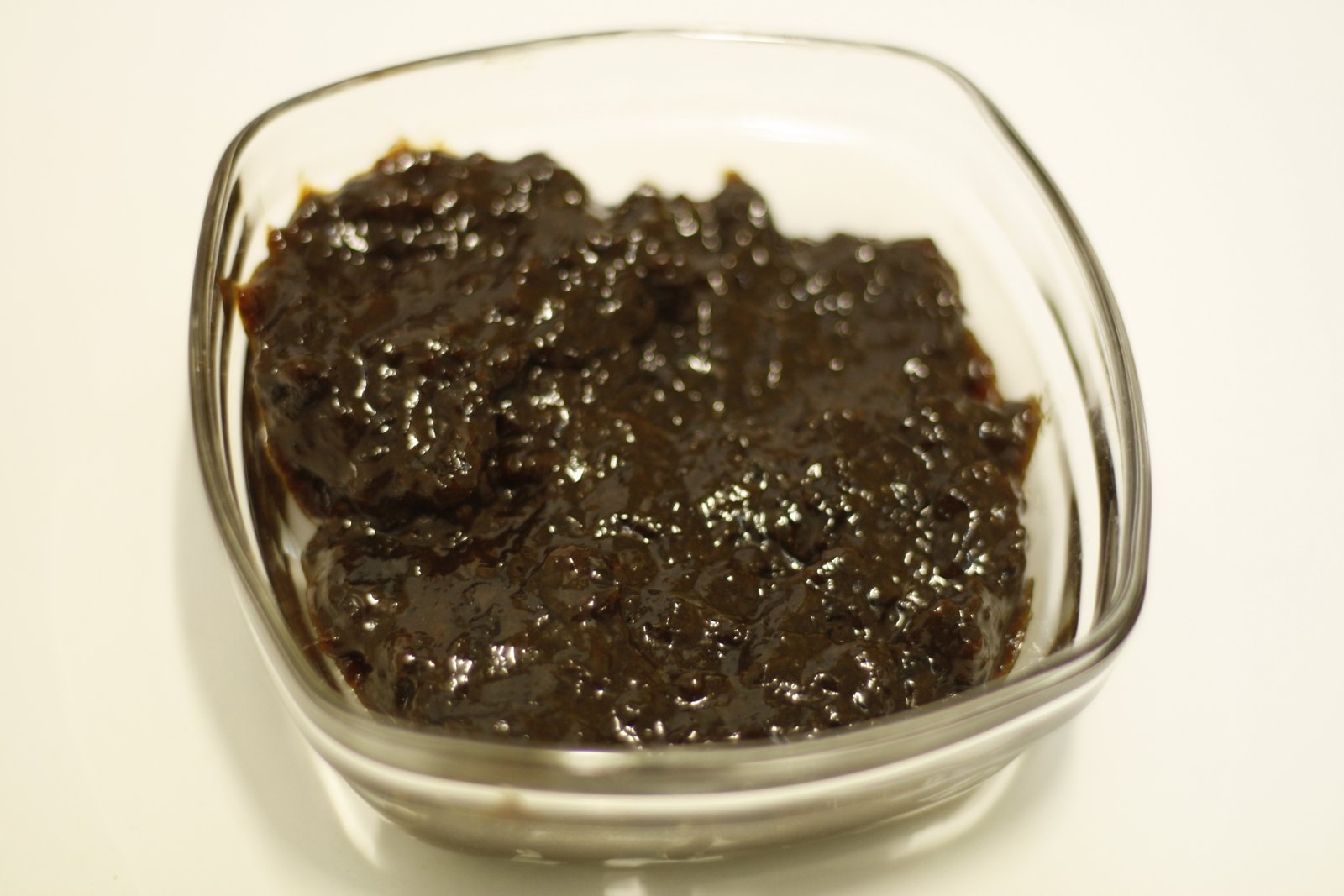
Tableside Service Hassidic Style:Tzibeleh Mit Eire
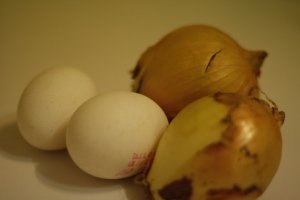 Remember table side service? Table side service was 1950s food fad which may be making comeback. In table side restaurants, which were usually tony places the chefs diced, minced and flambeed your supper right before your eyes.
In some traditional Jewish households table side service lives on every Shabbos morning when the head of the household performs an act of culinary theatrics when he creates an emblematic Jewish appetizer called Tzibeleh mit Eire or eggs and onions right at the table.
With family and guests watching, hopefully with rapt attention, the master of the house will mash the eggs, mince the onion and combine the two with a combination of oil and spices. And the results are magical, flavored by the Shabbos itself.
Don’t think this is a lowly job. Many important Chassidic Rebbes, the leaders of large groups of Chassidim perform this task each week with a flourish.
Tzibbele mitn eire is actually the simplest of all foods and yet it is considered a holy food fitting into the scheme of sevens that characterizes the menu of the Seventh Day, or Shabbos. Note that challah has seven ingredients. Fish gefilte or otherwise is called dag which has the Hebrew numerical equivalent of seven and tzibeleh?
Well forget the eire for a moment. Early sources say that in the old days the onion was eaten alone. The eggs came later when people became to soft to bite into a raw onion.
Now here’s a mathematical sleight of hand. In Hebrew an onion is a batzal which adds up to 140. Remove the multiple-that is allowed in this system of mystical math- and 140 magically turns into 14. But where do you get to seven? By cutting up the onion into half. No kidding.
Interestingly it is customary to eat eggs on Shabbos because eggs are Jewish foods of mourning and Moses, Moshe Rabeinu died on Shabbos. Sephardic Jews like to leave eggs in the cholent. After twelve hour simmering together with the Sabbath stew the eggs turn a toasty brown and are enjoyed as a delicacy called Huevos Haminados.
Tzibbeleh Mit Eire
3 hard boiled eggs
one medium onion diced
2-3 tablespoons olive oil
salt and pepper to taste
For Tu Bishvat:Etrog Confit
Tu Bishvat which is on Shabbat is the time to pray for a good etrog. An etrog, the citron, the Biblical “fruit of the goodly tree” is one of the four species used during the holiday of Succoth and finding a good one is no simple matter. As there are an almost infinite variety of specks and blemishes that can degrade an etrog or even render it possul, ineligible for ritual use, pious men spend hours picking over the fruit, often equipped with magnifying glasses and jeweler’s eye pieces to aid them in the task.
Even after one has found a perfect specimen, the question remains: what to do with this fruit once Succoth is over. Since an etrog is a holy object, it’s a violation of Jewish law to throw it away. Some people stud their old etrogim with cloves to create a natural besamim (spice) box for the havdala ceremony but how many besamim etrogs does one really need? And what is one to do when one has several -perhaps even a half dozen etrogim in need of repurposing?
My neighbor Gislaine Assouline large numbers of etrogim and cooks them into jam which she makes as a segula, a talisman for fertility and easy childbirth. Because of this, she only uses etrogim which were blessed during the holiday (possul or ritually disqualified etrogim don’t cut it with her) .At my son’s bar mitzvah Gislaine distributed her jam to an entire table full of pregnant cousins. Within the next few months they all gave birth to healthy babies .
The jam, it’s really a confit, isn’t hard to make but it’s a project which requires some advance planning. The results are scrumptious and you can bake the jam into a cake if you like.
- Etrogim
- Sugar
- Water
Clean etrogim well with soapy water. With a grater or microplane scrape the peel lightly to dislodge any dirt or insect remains.
With a sharp knife, slice the fruit into rounds and then into smaller rectangular pieces. Discard the fruit.
This jam is made from the peel.
Cover the slices with water and one tablespoon kosher salt. Cover jar
Let sit for a day, then pour off salty water and replace with fresh water.
Change the water once daily for the next two days.
By day three, the soaking water will have turned a bright yellow.
Then cook the etrog pieces together with water on a low flame for 40 minutes and drain.
Then add sugar to fruit. For one cup of etrog slices add ¾ cup of sugar and ¼ cup of water.
Simmer together in a covered pot checking every so often to see that the sugar is melting.
You goal is to create a syrup. Test to see that jam is ready by removing a drop of the syrup from the pot. If the drop widens on a plate and is sticky to touch, then it’s ready.
When it’s ready, close the flame and leave the mixture in a covered pot on the stove for 12 hours. Then store in glass or plastic jars and refrigerate.
Hubby’s Cholent
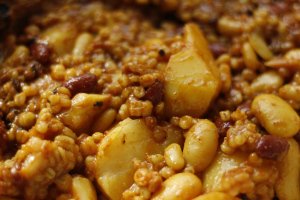
Cholent is the archetypical Shabbos stew, the Jewish answer to the French cassoulet except that cholent is cooked over night in a crock pot or on a covered stove, known in Yiddish as a blech. Yes blech is really a word. Speaking of words no one knows the origin of the word cholent. Some scholars say that it may derive from the French word “chaud’ meaning hot . Others trace it to the Hebrew word, “she talin” meaning “and it shall rest ‘referring to the stews lengthy cooking period . There are even those who claim that cholent is a ontraction of the words “shul ends” referring to the end of the prayer service. While the first two theories have some veracity, the last is a popular misconception.
Regardless of it’s etymology,cholent and its Sephardic equivalent Hamin are integral to the Jewish day of rest. What better way to solve the potentially intractable problem of providing hot food (to honor the Sabbath) when the Sabbath laws prohibit cooking. Since the cholent begins to cook before the Shabbos begins -the stew is left to simmer on Friday afternoon, the Rabbis hold that this form of cooking doesn’t violate Jewish law. The Karaites, a Jewish heretical group who took a misguided literalist stance objected to this supposed loophole and took their Shabbos meals cold. To show them wrong, the Rabbis made a point of eating their cholent piping hot which remains our practice.
Before home ovens were common, shtetl dwellers left their cholent pots at the local bakery on Friday afternoon and picked them up on Shabbos day just before lunch. As those old time ovens were quirky, the cholent’s homecoming was a moment of high drama. No one knew for sure whether the cholent which was left untouched in the oven would even be edible. Though some families brought home cholent tasting of charcoal most old timers recall our delicious the stew was, flavored with the special taste of Shabbos.
In my experience the cholent comes out the best when we have guests . Hostting guests is a mitzva and cholent is made for crowds Not only is it easy to make, but it can easily be doubled tripled or even quadrupled . Since it’s full of whole grains and legumes it is even healthy.
While most people eat cholent on Shabbos my mother always served it at her cousins’ club meetings on Sunday afternoons. The cousins most of whom no longer prepared the stew in their own homes reveled in this much loved taste from their childhoods.
Recently many Orthodox young men have taken to eating cholent on Thursday night . Though some mystics warn that this pre Shabbos sampling could have adverse consequences (not just digestive , but also memory loss)certain eateries in Brooklyn, Lakewood, Jerusalem and Bnai Brak do a roaring trade in the stuff. Of course these very same people will have cholent again on Shabbos morning. For some reason Thursday night cholent is a male rite favored by yeshiva students and young chassidim.I have yet to see a women or a person over thirty tuck in.
There are as many ways to make cholent as there are Jews . This is my family’s recipe, originally developed by my teen aged sons and adapted by my husband. Enjoy.
Soak one cup of barley, one cup of white and dark red beans and one cup of “bobes” beans (broad beans) in water, 12-24 hours before preparation of the chulent.
2. Defrost the chulent meat (about 2 lbs or one kilo. Meat on the bone is best)
3. Chop 4 large onions, fine
4. Heat up 2 tablespoons of canola oil in large, heavy pot
5. Fry the onions for 10 minutes
6. Cut the meat into large blocks and add to pot and mix with onions
7. Continue on low flame for 10 minutes
8. Add half a large can of tomato paste (2 cups) and stir
9. Continue on low flame for 10 minutes
10. Add water to cover meat
11. Wait to boil
12. Add spices, 1 teaspoon of each ingredient: salt, black pepper, turmeric, cumin, sweet paprika, curry powder, hot paprika, sweet chili,
13. Add 1-3 tablespoons of soup powder and 1 to 3 tablespoons of ketchup depending on your taste (or lack of it)
14. Add the barley and beans
14. Peel 4 to 6 potatoes, cut into large cubes, and throw into pot. Add water. The water level should stand about two inches (4 cm) above the ingredients. Remember that this is a stew, not a soup . Too little water will cause the cholent to burn .
15. Cook on low heat overnight
16. Consume in well-ventilated area
There is nothing awful about offal: Sauteed Miltz
Offal is the British name for animal gut, what we Americans euphemistically call or organ or “variety meats.’ I prefer the British term because it sounds like “awful” which is the opinion most people have of this type of food. Because organ meats are high in fat and cholesterol lots of people won’t touch the stuff. They will however gorge on Doritos and guzzle coke . Sadly most offal ends up in sausages or in pet food when we humans should be eating it because it is super-healthy, bursting with vitamins A and D, many essential fatty acids, and lots of macro and trace elements.
Of course our ancestors knew this. Offals of all kinds were favored ingredients in the Jewish kitchen. Remember the Bible story about Abraham feeding his angel visitors tongue? For centuries, miltz or spleen occupied a place of honor at Eastern Euopean Shabbos tables . The Talmud (Brachot 61 B) links spleen to laughter. Maybe that is why. By the way, scientists have found that a good laugh is a great aerobic workouts beneficial to body and soul What better time to laugh than on Shabbos?
ing. Last Friday night, when I served the miltz I was expecting guffaws and maybe even some boos. Instead, I got smiles and a compliment from my husband. “Tastes a bit like liver,” he said. Since my husband absolutely loves liver, that was a rave.
I didn’t taste the stuff. I was afraid to. Yes idea of eating chicken spleen put me off . On Sunday the fridge was almost bare and I was hungry so warmed up the left over miltz stirring in some spicy eggplant dip and setting it all on a bed of basmati rice. Delish. No kidding.
Here’s one way to make miltz
1 package of spleen (approximately 1 ½ lbs)
Soak in cold water changing the water several times until it runs clear. You can do this three or four times over the course of an hour
Blanch in boiling water for about 20 minutes
Pour off water.
Saute one onion in 2 tablespoons of chicken fat. (you can add one stick of celery and a half box of fresh mushrooms sliced if you want)
Add the drained miltz . Season with salt and pepper to taste. Moisten with tomato juice (about 1/3 cup)Cook for 15 minutes or until soft.
Serve over rice or stuff into patty shells (vol au vents)
Serves four as a main course of 6 to 8 as hors d’oeuvres.

Mamaliga
 Last week a brick of bright yellow cornmeal sitting on a supermarket shelfl sent me into gastronomic ecstasy. This wasn’t just any cornmeal It was KiTov, a food manufacturer specializing in insect free products. Insects, warehouse beetles, ants, moths and other things that creep are the scourge of the food industry. Nobody wants to eat them. According to Jewish law bugs are even more treyf than eating pork and Orthodox Jews invest long, and tedious hours in carefully checking grains, pulses and also certain fresh produce to make sure it’s bug free.
Now that KiTov has started to manufacture bug free cornmeal, I can just pour it from the package with a clear conscience. Of course cornmeal means Mamaliga. Mamaliga? Foodies might write it off as Jewish or Rumanian polenta but it’s a food that has found it’s way into many hearts.
In Rumania, mamaliga was commonly eaten for breakfast, lunch and supper In the early 20th century immigrants brought it to the US and it was even sung about in the Yiddish theatre.( Does anyone remember the old standard “Rumania Rumania.” “Ay Rumania Rumania Rumania, ” the crooner sings holding the high note and then goes on to the refrain “Ah Mamligaleh, a pastramaleh, a karnatzele (Rumanian meatball) and a glezzele vine (a glass of wine) but over the years mamaliga which requires a good quarter hour or more spent over the stove stirring a pot, has lost favor. Hardly anyone eats it anymore or even remembers what it is except for immigrants and their offspring.
I can still remember that childhood Sunday when my father and his younger brother comandeered my mother’s kitchen kitchen to cook up a batch. They weren’t just cooking; they were performing a culinary seance, channeling l the flavors of their Rumanian childhood home in their New York home . Ironically that comfort food has American roots. Corn or maize was a new world crop brought to Europe by the Conquistadors and then introduced to the Balkans by the Ottoman Turks introduced it to the Balkans so that the peasants could eat leaving the preferred wheat for the Turks.
This recipe comes from my mother who still remembers her own mother standing over the stove and carefully stirring it for 20 minutes or more to make sure it was velvety smooth and completely free of lumps. I’ve found that I can make it in less time and still achieve yummy results. If you want you can make a more solid mamaliga cook longer and then spread it out on a board and cut it into slices.
Mamaliga
1 cup best quality cornmeal
3 cups of water
1/2 cup milk
1 tablespoon butter
Salt
Bring the water, butter and milk almost to a boil, . Gradually dribble in the cornmeal stirring with a wooden spoon to avoid any lumps. Continue stirring for 10 to 15 minutes until you have a thick pudding with a cooked taste. You can add more water if it feels to thick. Serve immediately with a dollop of sour cream.
To reheat stir in a big more water or microwave. Enjoy
